The projects that the M1 students carried out in the context of the optional teaching unit « Training on Platforms » in 2025-26
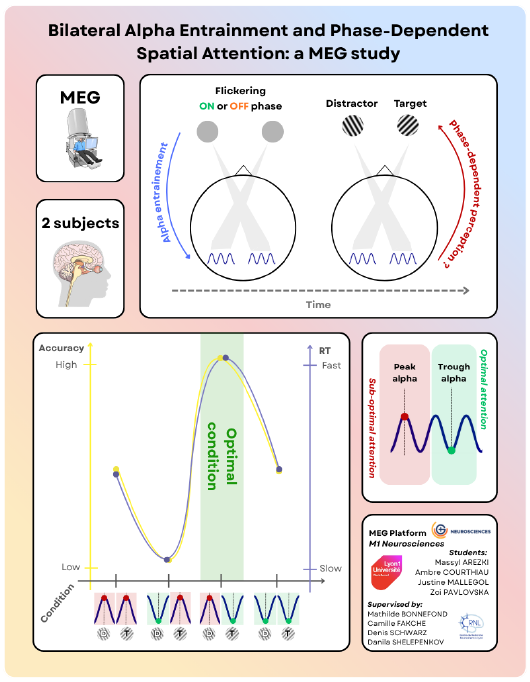
Bilateral Alpha Entrainment and Phase-Dependent Spatial Attention: a MEG study (MEG platform)
Students: AREZKI Massyl, COURTHIAU Ambre, MALLEGOL Justine, and PAVLOVSKA Zoi
Supervisors: Dr. FAKCHE Camille, SHELEPENKOV Danila, Dr. BONNEFOND Mathilde, Dr. SCHWARZ Denis
Alpha oscillations (8-13 Hz) are thought to gate sensory processing through rhythmic fluctuations in cortical excitability, with amplitude lateralization and phase both playing key roles in spatial attention. However, no study has manipulated alpha phase across both hemispheres within a single trial simultaneously. To address this gap, we employed a modified Posner cueing task with two spatially separated flickering stimuli designed to independently entrain alpha oscillations in each hemisphere at opposing phases. We hypothesized that performance would be optimal when the target appeared at the excitatory alpha phase and the distractor at the suppressive phase, and worst for the reverse condition. Two participants completed the task while MEG data was recorded to verify neural entrainment and alpha lateralization. A 20 Hz flickering technical error prevented assessment of phase-dependent behavioral effects. Accordingly, no significant modulation of reaction times or accuracy was observed across phase conditions. Nevertheless, MEG results confirmed robust neural entrainment at 20 Hz in both participants, and a significant alpha lateralization effect consistent with the spatial attention manipulation (permutation test, p = .02). These findings demonstrate proof of concept for the paradigm design and validate the lateralization component, while highlighting the need to correct the flicker frequency in future work.
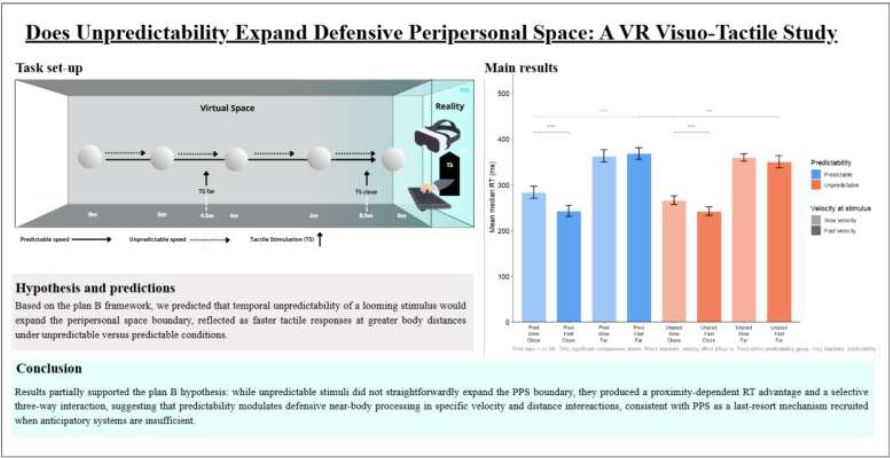
Does Unpredictability Expand Defensive Peripersonal Space: A VR Visuo-Tactile Study (NeuroImmersion platform)
Students: 𝐿𝑖𝑙𝑖 𝐵𝐸𝑁𝐷𝐼𝐾, 𝐶ℎ𝑎𝑟𝑙𝑖𝑛𝑒 𝑅𝐴𝑉𝐼𝐸𝑅
Supervisors: 𝐴𝑙𝑒𝑠𝑠𝑎𝑛𝑑𝑟𝑜 𝐹𝐴𝑅𝑁𝐸, 𝐶𝑙é𝑚𝑒𝑛𝑡 𝐷𝐸𝑆𝑂𝐶𝐻𝐸
Peripersonal space (PPS) is a dynamic multisensory representation of near-body space, supporting interaction with nearby objects and defensive responses to approaching events. Theoretically, PPS functions as a last-resort defensive mechanism recruited when anticipatory systems fail, suggesting that stimulus unpredictability should be a key modulator of PPS engagement, yet this has never been directly tested. This study tested whether predictability of a looming visual stimulus modulates PPS recruitment in a virtual reality visuo-tactile paradigm. Eleven healthy adults responded to tactile stimuli while a looming object approached at varying speeds and distances. Predictability (predictable vs. unpredictable speed profiles), approach velocity (slow vs. fast), and stimulation distance (close: 0.5 m vs far: 4.5 m) were manipulated in a within-subjects design. Reaction times were analysed using linear mixed model, complemented by a near-far facilitation index and subjective ratings. Results showed robust distance-dependent facilitation: responses were faster for close than far stimulation, confirming PPS-related multisensory facilitation. Velocity modulated this effect, with larger facilitation for fast than slow stimuli. Predictability effects were selective: unpredictable trials produced faster responses in some conditions but did not significantly expand the overall near-far facilitation index.
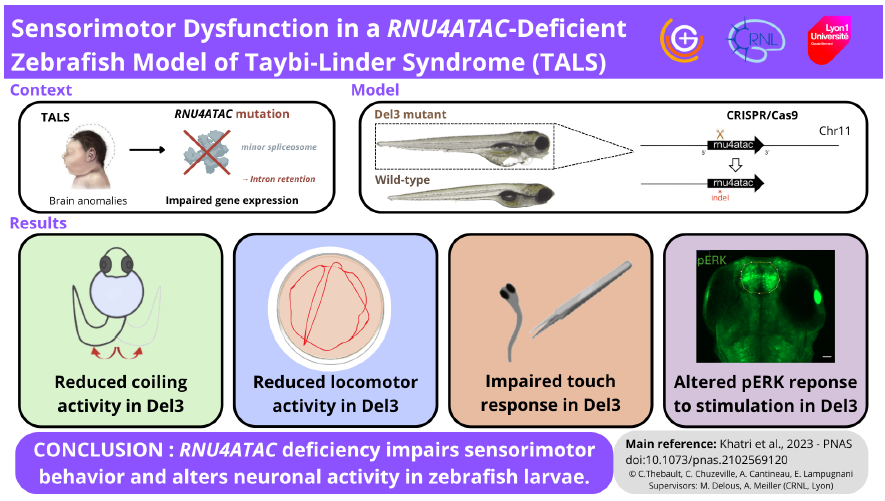
Sensorimotor Dysfunction in a RNU4ATAC-Deficient Zebrafish Model of Taybi-Linder Syndrome: Neuroimaging and Behavioral Analysis (Zebrafish platform)
Students: Candice Thebault, Clara Chuzeville, Alice Cantineau, Eimear Lampugnani
Supervisors: Dr Marion Delous, Dr Anne Meiller
Taybi-Linder syndrome (TALS) is a rare autosomal recessive developmental disorder caused by mutations in RNU4ATAC, which encodes the U4atac small nuclear RNA (snRNA) component of the minor spliceosome. Minor spliceosome dysfunction leads to retention of U12-type introns, disrupting genes involved in neuronal signalling, ciliary function, and ion channel activity. To investigate the pathophysiological mechanisms underlying neurological deficits related to TALS, we used a novel CRISPR/Cas9-mediated zebrafish mutant line (Del3) mirroring the loss of RNU4ATAC function observed in humans. Four complementary experiments were conducted: (1) pERK immunostaining to visualise neuronal activity in the forebrain; (2) light/dark locomotion assay, measuring swimming distance and speed; (3) touch responsiveness assessment using tactile stimulation; and (4) spontaneous coiling behaviour analysis. Homozygous mutant larvae showed severe impairments across all behavioural measures, displaying complete loss of locomotor activity, significantly reduced touch response, and decreased coiling behaviour compared to wild-type and heterozygous siblings. Surprisingly, pERK analysis revealed no significant increase in forebrain pERK intensity following sensory stimulation in either WT or Del3 larvae. However, stimulated WT larvae exhibited higherpERK intensity than stimulated Del3 mutants, suggesting a possible alteration of neuronal responsiveness in mutants under sensory stimulation conditions. These findings demonstrate that RNU4ATAC deficiency impairs sensorimotor function, potentially through altered neuronal activity-dependent signaling pathways, providing insights into the neurodevelopmental mechanisms of TALS