M2 CNS - Teaching Program
Computational Neurosciences
The Master is organized into two semesters: the first semester focuses on courses, while the second semester is dedicated to a six-month internship. The first semester is organised in 3 blocks : tools, specialised courses and Computational neurosciences seminars.
Block 1 (September-October) contains statistics, elements of neuroscience, mathematics, and Python programming + an English course for neuroscientists. Block 2 (October-November) includes three main courses: Neuroconferences, PhyMod and CogMod. Block 3 (December) consists of talks by leading experts on recent advances in computational neuroscience (NeuroComp)
Optional units are offered to specialize in different areas of computational neuroscience, from clinical approaches, cognition, artificial intelligence or even neurotechnologies.
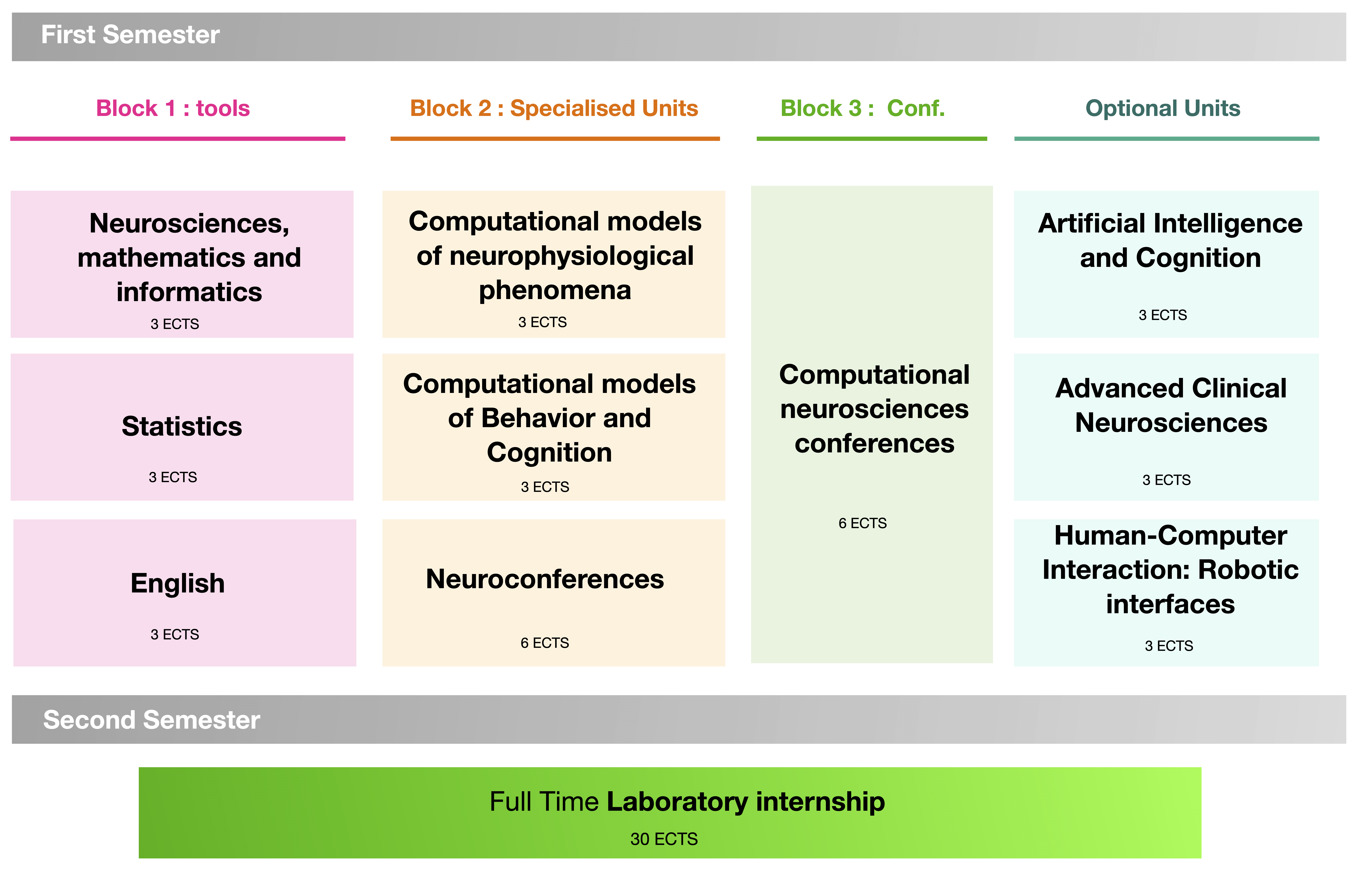
First Semester
Block 1: Tools (September-October)
Block 2 : Disciplinary (October-November)
Block 3: Comp-Conf (December)
Elements of Neurosciences, Mathematics and Informatics (NMI)
- Foundational knowledge in neuroscience: Neuroanatomy (J. Sallet),
- Multiscale electrophysiology (C. Amat) and Neuropsychology (I. Cristofori).
- Foundational knowledge in mathematics: Linear algebra and Dynamical systems theory, Ordinary Differnential Equations ODE (M. Di Volo)
- Probability theory and Byesian approach (F. Lecaignard).
- Foundational knowledge in python programing for neurosciences through pratical works. Machine learning (linear decoder, logistic regression, …) applied to experimental datasets of neural recordings (M. Di Volo and G. Bondanelli)
- Numerical simulation of ODE for neuonal dynamics in python – Integrate and Fire, Izikevich, Hodgkin-Huxley (Matteo Di Volo).
Coordinator/s: Matteo di Volo (matteo.di-volo@univ-lyon1.fr)
Statistics
This unit teaches advanced statistical methods used in biology and neuroscience: non-parametric tests, ANOVA (multiple factors), linear/logistic/mixed regressions, PCA/CFA, classification methods (decision tree etc..).
More info: Stats
Coordinator/s: Matteo Di Volo (Matteo.di-volo@univ-lyon1.fr) & Marion RICHARD (marion.richard@univ-lyon1.fr)
English
English courses specifically designed for scientific communication. This includes writing of scientific articles, training for poster presentation, job interviews and writing letters for editors/reviewers.
More info: English
Coordinator/s: Nathalie DOURLOT (nathalie.dourlot@univ-lyon1.fr)
Computational models of neurophysiological phenomena (PhyMod)
PhyMod covers methods to model and analyze brain electrical activity across multiple scales, from single neurons to neural network up to whole-brain signals such as EEG and MEG. The course covers the following topics:
- Computational models of neural networks, including neural dynamics, spiking neural networks and models of interacting neural populations (M. di Volo).
- Computational models of the whole brain and large scale signals – EEG and MEG (E. Koksal).
- Advanced methods in electropgysiological data analyses: dynamics of neural population activity through spike-based analyses, emphasizing manifold and geometrical approaches to characterize population dynamics. The course includes extensive hands-on sessions using real electrophysiological datasets ( G. Bondanelli).
- Advanced methods in data analyses of neural oscillations in electrophysiological signals, LFP and MEG (J. Bonaiuto)
Coordinator/s: Matteo di Volo (matteo.di-volo@univ-lyon1.fr)
Computational Models of Behavior and Cognition
The aim of this teaching unit is to train students in computational models of the major cognitive functions (learning, decision-making, executive functions such as attentional control and the role of working memory…), in particular through their influence on behavior (our choices, our errors and our speed of response). We will also cover how these models can be used to explore the neural basis of these cognitive functions. This teaching unit will focus in particular on the major families of models such as artificial neural networks, reinforcement learning and probabilistic or Bayesian approaches to cognition. The course covers the following topics:
- Bayesian models of perception, action and cognition (J. Daunizeau, F. Lecaignard, M. Joffily)
- Reinforcement learning models and tasks – practical sessions (R. Ligneul, J. School)
- Decoding approaches – practical session (R. Quentin)
- Modeling decision making, trading speed and accuracy (D. Thura)
- Deep learning models and cognitive neurosciences (E. Reynaud)
- Brain-Computer Interfaces & Neurofeedback training (J. Mattout)
Coordinator/s: Jérémie Mattout (jeremie.mattout@inserm.fr)
Neuroconferences
Scientific conferences given by French and international experts on hot topics in the different levels of analysis covered by Neurosciences. Topics are renewed each year. Extensive time is dedicated to discussions between the students and the speakers, aiming to develop in-depth scientific reasoning and networking.
Coordinator/s: Marion RICHARD (marion.richard@univ-lyon1.fr)
Computational Neurosciences
A series of scientific conferences given by nationally and internationally recognised experts on current topics in the field of computational neurosciences. Emphasis on duo talks by an experimentalist and a computational model expert. See here the program for 2025/202 NeuroComp
Coordinator/s: Matteo di Volo (matteo.di-volo@univ-lyon1.fr) & Jérémie Mattout (jeremie.mattout@inserm.fr)
Optional Units
Artificial Intelligence and Cognition
This course sets out the fundamentals of the field of Artificial Intelligence (AI), enabling us to understand the different approaches (symbolic AI, digital AI, computational AI, strong AI, etc.). This course will define the relationship between AI and cognition, as well as the cognitivist and constructivist positions, enabling an understanding of the different currents in AI, their contributions and limitations. A particular focus will be placed on developmental AI, which is currently booming.
More info: AI Cog
Coordinator/s: Marie LEFEVRE (marie.lefevreuniv-lyon1.fr)
Advanced Clinical Neurosiences
Conference series by national and international experts presenting different levels of analysis covered by clinical neurosciences. A special emphasis is given to cutting-edge methodologies used to study the neural underpinning of brain dysfunctions in neurological and psychiatric diseases. Extensive time is dedicated to discussions between the students and the speakers, aiming to develop in-depth scientific reasoning and networking.
Coordinator/s: Irene CRISTOFORI (irene.cristofori@univ-lyon1.fr) & Frédéric HAESEBAERT (frederic.haesebaert@ch-le-vinatier.fr)
Human-Computer Interaction: Robotic Interfaces
The design or correction of digital interfaces currently represents a major part of Brain machine interfaces activity. This course will present the different players involved in designing a digital interface and how they work together. The course will focus on presentations of the different methods available to the designer. Finally, students will be asked to design an interface of their choice in small groups.
Coordinator/s: Emanuelle REYNAUD (emanuelle.reynaud@univ-lyon2.fr)
Second Semester
Internship
Full-immersion in the world of research in Computational Neurosciences for a period of 5 to 6 months. Students can do their internship in Lyon, in other French laboratories or abroad.